Solution Evaluation
Body Composition Module Quick Selection - Product Fit, Accuracy Difference, and Integration
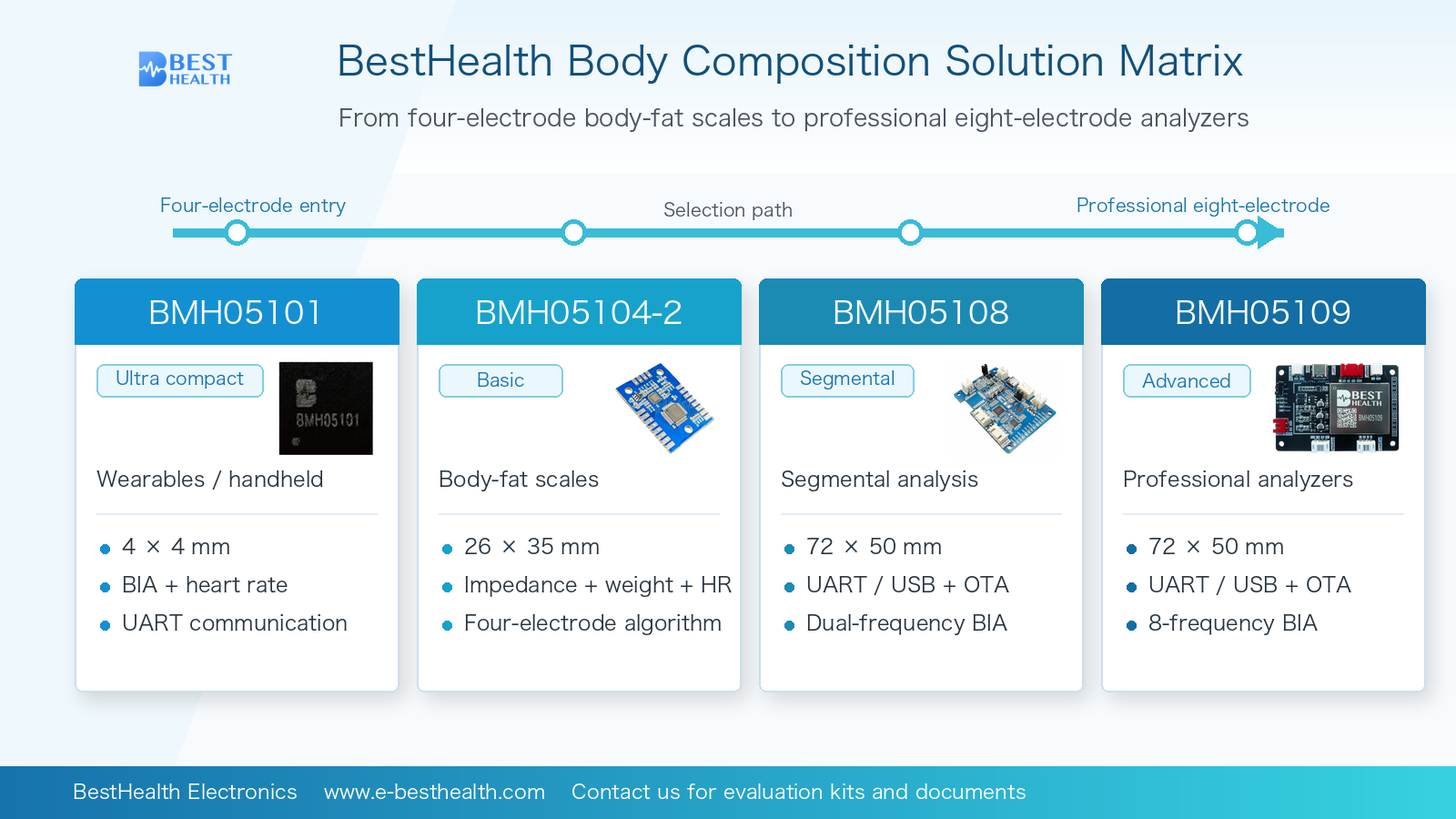
For product managers, buyers and engineering teams new to the BestHealth body composition solution, this article first answers four first-pass questions: which modules are available, what product each fits, how much accuracy differs between four-electrode and eight-electrode solutions, and how to integrate the module into the finished device. It then compares BMH05104-2, BMH05108 and BMH05109, and explains what makes a strong body composition solution: a self-designed BIA measurement front end, validation data, certification support, SDK/API completeness, structural design support and response speed.
Solution Evaluation
Validation Results - BestHealth Body Composition vs Hospital DEXA and Professional BIA Devices
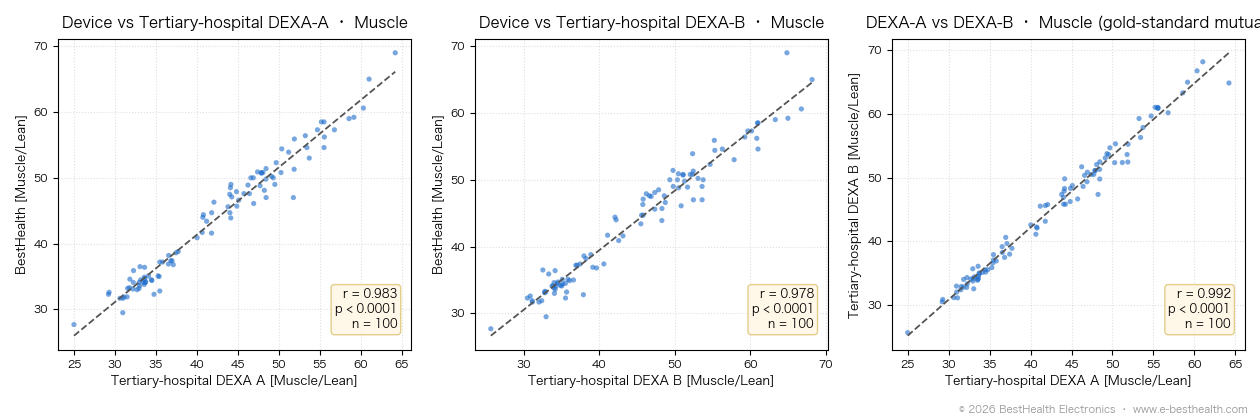
For manufacturers evaluating the BestHealth BMH05104-2 / BMH05108 / BMH05109 body composition modules and looking for accuracy-validation data, this article publishes same-period comparison results from a 100-person cohort: against two tertiary-hospital DEXA references (the gold standard), muscle mass correlation is 0.978-0.983; against marketed professional BIA comparison devices, fat-free mass, skeletal muscle mass, fat mass and body-fat percentage correlate 0.978-0.995; dual-hospital DEXA cross-validation provides an additional reliability reference.
Body Composition Principles
BIA Body Composition Measurement Principles and Four / Eight-Electrode Selection
Starting from the conductivity principle, this guide explains how BIA measures body composition, what the resistance and reactance inside impedance represent, why a four-electrode setup is required instead of two, and the difference between single and multiple frequencies. It then compares four-electrode (two-leg / two-arm) and eight-electrode (segmental) approaches by measurement path, output items, accuracy, cost, and product form, to help you pick the right approach and module for scales, wearables, and professional analyzers.
Engineering Debugging
How to Use Impedance Data to Troubleshoot BIA Body Composition Measurement
A BIA measurement debugging guide for the BMH05104-2 / BMH05108 / BMH05109 body composition modules, covering why to go back to raw impedance data, normal impedance magnitudes (the eight-electrode body model), a check order of stability then frequency relationship then segmental symmetry, and how to locate common faults in electrode contact, cable parasitic coupling, broken wires, and measurement posture.
Solution Evaluation
How to Validate Body Composition Accuracy - A DEXA Comparison Methodology
For manufacturers building body composition products on the BMH05104-2 / BMH05108 / BMH05109 modules who need to prove "it measures accurately" to customers or the market, this guide explains why to use DEXA as the gold standard, what BIA accuracy validation should prove, why this article uses correlation as the main validation metric while bias and reproducibility can serve as supplemental analysis, how to design the validation cohort (sample size, gender, age and body-type coverage), how to control measurement conditions, and common pitfalls such as treating a same-type BIA device as the gold standard or hospital DEXA only reporting bone density.
Hardware Design
Body Composition Hardware Design Guide - Electrodes and Cabling
For hardware engineers building body composition products on the BMH05104-2 / BMH05108 / BMH05109 modules, this guide covers from the design stage how to set electrode position / size / material / spacing, the relationship between module compliance voltage and contact impedance, how to choose electrode cable core / shielding / routing specs, and how to design in testability - so parasitic coupling and contact problems are suppressed at design time rather than chased after mass production.
Solution Integration
Body Composition Algorithm Selection and Integration Guide
For manufacturers building body-fat scales, analyzers, and wearables on the BMH05104-2 / BMH05108 / BMH05109 modules, this guide explains the selection boundary of BestHealth module built-in body composition algorithms, the impedance location, frequency, electrodes, and output items of TwoLegs / TwoArms / Body120 / Body270 / Body810, and where optional Web API / Android / iOS, mini-programs, customer-platform adaptation, and paid custom algorithms fit.
Engineering Debugging
How to Use ADC Data to Verify the Weight Function of a Body Composition Module
A debugging guide for BMH05104-2 / BMH05108 / BMH05109 weight functions, covering why each unit must be calibrated and why calibration uses weights near full scale, how to collect and prepare ADC data, judge stability and linearity, and troubleshoot sensor wiring, half-bridge/full-bridge structures, and reversed ADC changes.